
Study timetable for exams is the most important tool for any student who wants to score good marks without stress. A proper plan helps you manage your time, stay consistent and revise everything on time.
KEN Toolkit – Student Tools, Study Planner & Calculators provides free student tools online that help students create smart study plans and improve their exam preparation.

A study timetable is not just a schedule; it is a success plan. Without planning, students often face:
- Poor time management
- Last-minute pressure
- Missed topics
- Low confidence during exams
A good timetable gives structure and control over your study routine.
Table of Contents
Step 1: Understand Your Subjects
Start by listing all your subjects. Divide them into:
- Hard subjects (Math, Physics)
- Medium subjects
- Easy subjects
This helps you decide how much time each subject needs.
Step 2: Create a Realistic Schedule
Do not create an unrealistic plan. Keep it simple and achievable:
Example daily routine:
- Morning: 2 hours study
- Afternoon: break or light revision
- Evening: 2–3 hours study
- Night: 30–60 minutes revision
Consistency is more important than long hours.
Step 3: Use Free Student Tools Online
Today, students can make planning easier using digital tools.
You can use:
👉 free student tools online
👉 study planner tools
👉 KEN Toolkit study planner
These tools help you create and manage your study timetable for exams in a smart way.
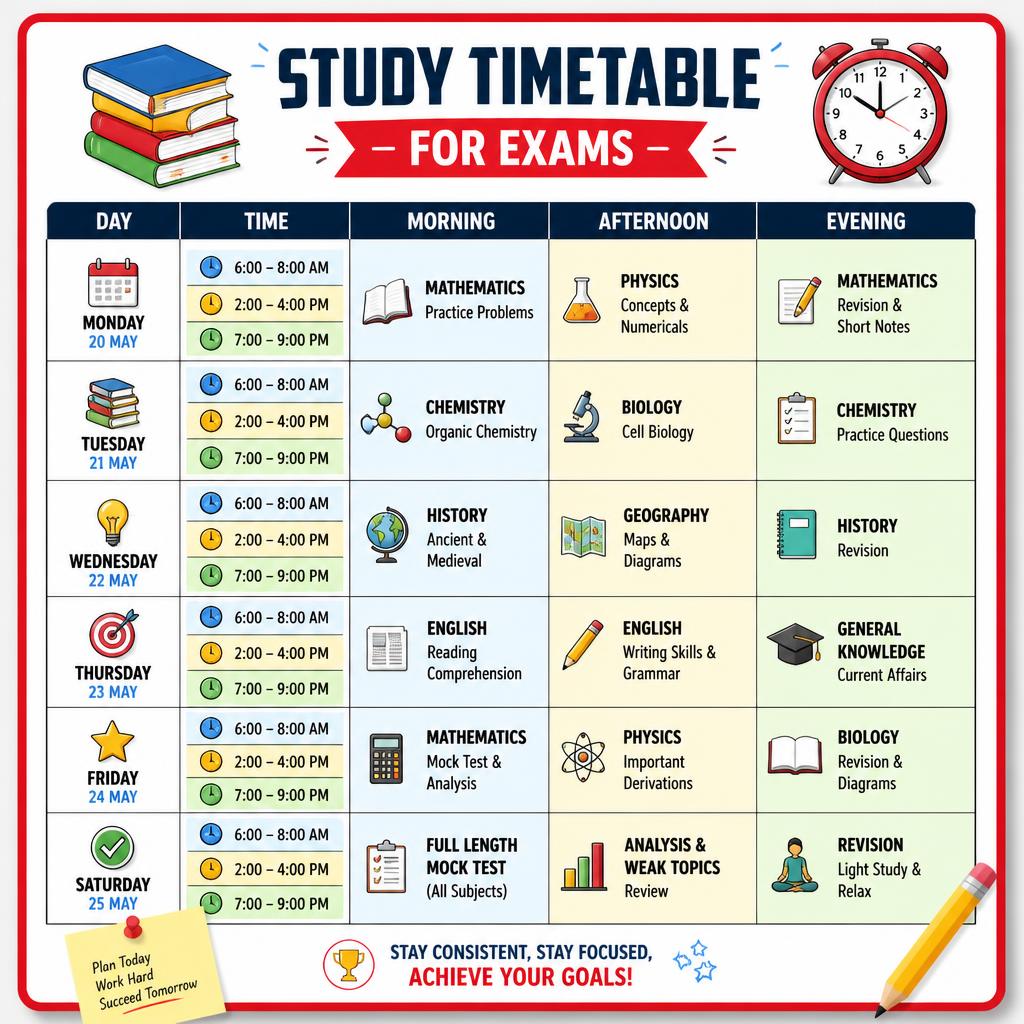
Step 4: Build a Flexible Study Timetable
A perfect timetable is flexible, not strict.
Example:
- 1 hour – Mathematics
- 1 hour – English
- 1 hour – Science
- 30 minutes – Revision
Always include short breaks to avoid stress.
Step 5: Daily Revision is Important
Revision is the key to long-term memory.
- Revise daily for 30–60 minutes
- Weekly full revision session
- Focus on weak areas
This improves your exam performance significantly.
Step 6: Manage Exam Stress

Exams can be stressful, but proper planning reduces pressure:
- Follow your timetable daily
- Avoid overthinking
- Take proper sleep
- Keep short breaks
A calm mind performs better in exams.
Final Tip for Students
If you want better results, don’t just study hard—study smart.
Use:
👉 study timetable for exams
👉 student tools online
👉 free student tools online
KEN Toolkit – Student Tools, Study Planner & Calculators helps students plan better and achieve higher marks with simple tools.
Conclusion
A well-planned study timetable for exams can completely change your academic performance. It brings discipline, reduces stress, and improves focus. With the help of free tools and proper planning, every student can succeed.